Tuesday, November 29, 2011

Islamic Republic Enters Danger Zone


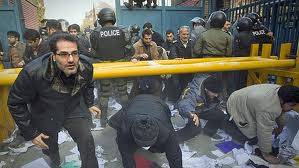
"Britain cannot expect acting against the Islamic Republic's interest without any consequences", said yesterday the Chair of the Foreign Committee of the Islamic Republic Parliament. This is surely a clear indication that the invasion of the British Embassy yesterday in Tehran has been discussed and decided at the highest level of the country political and military apparatus. This also underlines the urgency of dealing with a dangerous few seriously threatening  the international peace and stability. They are none but those small numbers of military people who orchestrated the presidential election coup against the people of Iran over two years ago. They have taken Iran; its national wealth; and of course its people hostage. What do they really want? They basically want to be left alone to do whatever they want to whoever they see fit to only serve their own interests. They did it to the people of Iran and their country. They have been working hard to bring the Middle East and wider region under their clout. And now, with their intention to acquire the big B; they have targeted the international community. Invasion of an embassy and taking its diplomatic staff hostage is no difference than taking the international community hostage in wider scope.  

Monday, November 28, 2011

Final Exam

I have finally done the final exam of my LLB (Bachelor of Law) course last Friday. Having sat at an exam you know that is your final exam of the final unit of your study feels like a marathon runner sees the finishing line few meters away. The course has been part of a combined Arts (major politics which I received in 2008) / Law degree I entered in 2005. It was a 5 years full-time course and I should have finished it sometimes in late 2010, however, I deferred the course in 2010 and studied Post Grad immigration law for almost a year. Nevertheless, there will still be 6 months spending in the College of Law NSW for a Graduate Diploma of Legal Practice.

All these do not suggest a bit that I ignore the dictator and his collaborators.

Thursday, September 29, 2011

Back to the old design

Many visitors of this site were apparently not using, and/or unable to use, the Dynamic View of this page provided by Google. Therefore I decided to reverse it to the old view version. I hope this would help. I am sorry for any inconvenience caused.

Sunday, September 11, 2011

Why should the people of Iran eschew any future election held in the country?

The military controlled regime in Tehran; seriously uncomfortable watching the Libyan-Syrian developments, has embarked on a parliamentary election-campaign. It has released over 70 political prisoners mostly reformists politicians and encouraged the opposition participation in the coming election. The regime desperately needs the people participation. It is crucially important for the regime to depict a different political picture of Iran than to that of the Libya-Syria's and/or the ones of Egypt earlier. But the bad news for them is that the Iranian people are much smarter than them in a sense that what the people did; by the participation of close to %80 in the last disputed presidential election; was to put the regime at an election point.

That was electing between the return of the sovereignty to its rightful owner; the people of Iran OR standing against them ie a soft military coup. The regime wrongly elected the latter. The regime, say Ayatollah and his military people, was, however, right on anticipating that the road Iranians were putting them on was the same road as Mubarak of Egypt gone; Ghaddafi of Libya is almost there; and Assad of Syria must reach. But what Ayatollah and his military should ask themselves now is this; was it worthed? Only a few years more in power? At what costs to the Iranian people and their country?

They are now in a rather worse position than before; dire indeed, when talking about the parliamentary election and even future presidential one. Ayatollah is in desperate need to depict a different dictator than those mentioned above, he is right, to be fair to him, to the extent that he doesn’t speak Arabic! And he has no choice but to encourage Iranians to participate in the election. That was the reason behind the release of over 70 political prisoners recently, mostly reformist politicians. They even displayed the former president Khatami to speak about the importance of the election.

I seriously believe that Ayatollah and his military culprits gravely underestimate the Iranians’ political astuteness. That is obvious for they still do not realise the gravity of the ball people put into their court. They illusionary credited the people’s participation in that election to their own political smartness. But they may come to grasp the reality this time around, when Iranians stay at home for any future election to the same effect of what they did over two years ago. That is simply because the last time we, and the outside world, were being shown by the people what they want; and they will demonstrate the same want by sitting at their homes; on any days called the election-day; in future.

The people of Iran planted the seeds of human rights and democracy for the people of the Middle East and Africa whom are now enjoying the fruits.

Iranians are deserved the same fruits and they are going to taste it soon-I am positive.

Saturday, August 27, 2011

Gaddafi gone; Assad faces the same fate; Khamenei has panicked

Before the Friday Sermon in Tehran last week, President Ahmadi Nejad has addressed the prayers. In his speech, he has questioned the Holocaust, again, and threatened Israel. While his appearance in the sermon and the threats made against Israel should be examined in the context of the political developments in Libya and Syria, it still has its old link to the 2002-2003 invasions of Afghanistan and Iraq.  

Tehran has been using the rhetoric since 2005. At the time the Islamic Republic seriously believed that, after Mola Omar and Saddam, it is the next US' target. It appeared that they needed a deterrent against any possible future aggression. Particularly when their friendly gesture by the former president Khatami had been dropped on the deaf ears of the then US President George W. Bush and Dick Cheney whom rather aggressively rejected the gesture. Since then whenever pressures on Tehran increase, whether it be political, nuclear or military; President Ahmadi Nejad repeats the threats. The over usage of these threats, however, somehow turn them into an empty rhetoric. What makes the rhetoric more ridiculous today is the fact that Bashar Al Assad, Tehran's strategic partner in the region, is awaiting his fate to be handed down by the Syrian people. It is pretty clear, from the daily news coming out of the country, that now that Gaddafi has departed, Assad is in the departure lounge waiting! One can only hope that Tehran familiarises itself with these realities sooner than later.

However, if Tehran still insists that spending billions of dollars of Iran's money on the Middle Eastern terrorist organisations such as Lebanese Hezbollah or Palestinian Hamas or country such as Syria is their insurance policy against their human and democratic liabilities owed to the people of Iran; they are fatally mistaken. By Assad's departure, when it comes, Tehran would face the people of Iran and their democratic demands. Regime in Tehran would then neither be in a position to dictate its terms to its own people nor to the outside world.

Finally the only message one can relay to Tehran is that: instead of shouting threats, it would be wiser to simply acknowledge the new reality of the Middle East; a Dictator-Free Middle East. The new Middle East would not entertain dictators, and it would be embarrassingly naive to think otherwise. Millions of new generation Iranians have already handed down their verdict on the legitimacy of the regime in Tehran. Hence Tehran, take the Iran's political system into the operating room and get on with the well-over-due critical surgeries! Otherwise it would be a costly exercise to make you realize the new order.  

Notwithstanding of the foregoing Tehran's shouting is not a bad thing in itself after all. It tells us that; they are worry.

Wednesday, August 17, 2011

Islamic Republic Only Responds to Real Power

President Ahmadi Nejad of Iran has signalled the Islamic Republic's positive view towards Russian step-by-step nuclear offer. The offer has been on the table for a long time but the Islamic Republic had categorically rejected it before. The question is what has forced Tehran to change its view now.

Perhaps we should search for the reason on the other side of the globe in Washington. The US State Department is reviewing its terrorist organisations list. And the People's Mojahedin E Khalgh (MEK) of Iran, the most organised opposition group to the regime of Tehran, has a real chance of being removed from the list. While the Tehran's recent response may well be a tactical one to derail the possibility of the MEK removal from the list; it once again corroborates the true nature of a regime which is extremely vulnerable against its own people, internally. 

Conscious of this reality combined with the fact that the MEK is the only group among the opposition of the IRI abroad capable of standing against the Tehran's military machine; the IRI had no choice but to take a much more prudent approach. Especially after Egypt; now in Libya and imminently in Syria; the Iranians are witnessing how easy is to get rid of a dictator. The IRI therefore decided to utilise its main bargain chip, the disputed uranium enrichment, against the US. However, at the time of writing the IRI mobilizes its former president, Muhmmad Khatami, the West-sweetheart, as well to publicly announce his intention to run for the presidency in the coming presidential election next year. Both the nuclear signal and the Khatami's announcement are designed to cloud the State Department's mind. But what the IRI also flagged inadvertently was its vulnerability and apprehension. The IRI will do, I believe, whatever it takes to hinder the possibility of the MEK's removal from the list first. And it will also go to any extent necessary to keep the flares of the Egyptian; Libyan; and the Syrian revolutions away from the highly flammable Iran's society.

But the US must be very cautious in dealing with President Ahmadi Nejad and his friends in Tehran. Their announced readiness to discuss the Russian nuclear offer is only that; "readiness to discuss", nothing more. It does not necessarily mean anything. They have over played this tactic before and are known for using such tactics as long as it serves their purpose. It is now up to the US as to whether it falls into the same trap once again or not.

The MEK's members are the only people determined enough to stand and fight back the kind of atrocities committed against the peaceful Iranians by the Revolutionary Guards; its paramilitary branch(Basijis); police; and their plain cloths organised pressure groups over two years ago. The IRI therefore sees the MEK as the only credible threat, in a sense of fighting its fully-armed military machine, to its existence. As a matter of fact, since the invasion of Iraq in 2003, it has done all it could through its proxies in Iraq to eliminate this group in Camp Ashraf.

The US has a golden opportunity to remove the group from its terrorist list now; and assisting itself by assisting the Iranians in their battle towards human rights and democracy.


Tuesday, August 9, 2011

Thank you

Something good and interesting has happened this week. I don't know how but it is extremely encouraging. Number of readers on my both blogs English, here, and the Persian, Farsi, here, has jumped by almost two hundred percent. I thank you all for your time spent here. That gives me extra needed energy to up-date my blogs more regularly.

I believe we are going through a period of political transformation in the Middle East, Africa and the wider world. While few dictators of the regions have already been toppled; the Libyan; Syrian and the one who speaks my language are desperately resisting. That is why I strive to write as much and as often as I possibly can here. We need to monitoring the situation on the grounds in those countries constantly and continuously. We then convey unfolding events and information to the wider audience promptly. That is my intention. 

Wednesday, July 20, 2011

Bashar Al Assad's Time Is Up

The Assad's regime in Syria is at the verge of collapse. Reports, however, suggested that the Revolutionary Guards and Police of the Islamic Republic are desperately trying to save his regime. I am not particularly concerned about Assad, his regime or the Syrian people; that is their problem. But when it comes to reasons for Tehran to get behind its strategic partner; I am very concerned. Simply because those reasons directly link to the human and democratic rights of the people of Iran.

Since the collapse of the Soviet Union over two decades ago, in 1989-90, it seems that Syria and the Islamic Republic have tied their convenient alliance to such extent that it now appears the livelihood of one is a prerequisite for the other's. This has become even more evident after the military arrival of the United States and its allies in the Middle East-the invasion of Iraq. The Islamic Republic feels vulnerable and seriously exposed. That is why it has always used the vulnerability of Israel in its neighbourhood as the only lever available to it against the US military might. Perhaps that explains the Tehran's mentality to send its military and police advisers; even though reports suggest that their forces are on the ground as well, to assist the Assad's regime holding on to power.

Furthermore, both Tehran and Damascus have smelled the scent of Jasmine all over the Middle East and Africa! It was only two years ago when reports from Tehran suggested some tall; ugly faced; Arabic speaking forces were on streets of Tehran and other Iranian cities crushing the peaceful Iranian demonstrators. It now seems that Tehran is paying back the Damascus' favor!

However, the both capitals are missing a critical point. The change of political systems in the Middle East is inevitable. People of the region are now, thanks to the powerful and pervasive social networks available to them, aware of their basic rights and the true value and rights of being a citizen in a country. Change-Train is heading forward full-steam; and is unstoppable. What indeed is unfolding before our eyes is a developing fact that "the Iranian Nuclear-Train" - which President Ahmadi Nejad has long been referring to as not having a break and/or a station along its route - is in fact the Democracy-Train. It is moving ahead fast and needless to say that anyone with sound-mind should not stand on its track.

p.s. By the way; I am not naive of the fact of Neo-liberalism existence and its global agenda, however, on the balance; I believe we should rely on our people only!

Wednesday, July 6, 2011

Generals Rule Iran

General Mohammad Ali Jafari, the head of the Iran's Revolutionary Guards Corps, has made it clear that Iran is being officially ruled by military. In an interview this week he has outlined the requirements for a politician, in particular he mentioned former president Mohammad Khatami, to participate in Iran's politics! 

While generals being the ushers of Iran's politics since the last rigged presidential election has been a widely perceived fact both inside and out of the country, this is the first time that the top general has publicly drawn lines for politicians in Iran.

The general was speaking after president Ahmadi Nejad had dropped a bombshell on his military organisation earlier in the week accusing it of smuggling goods into the country using its many ports operating independently and undetected by the country's custom authorities. President Ahmadi Nejad suggested that the general and his colleagues may have other interests, rather than their ideology, to protect after all. "Iranians are smoking close to two billions US dollars value of cigarettes each year; the amount is so big motivation for first class smugglers in the world including "our revolutionary brothers", president Ahmadi Nejad gave an example at a conference for fighting against smuggling held in Tehran last week.

Generals were not happy at all about the remark. Mohammad Ali Jafari denied the suggestion and defended his organisation assuring the proper running and the legitimate use of their controlled ports. It is no secret, nonetheless, that the Revolutionary Guards Corps has been involved in all sorts of business activities in recent years. They have bought into a wide range of money making businesses from the telecommunications and infrastructures to win oil and gas projects without tender! They now, according to reports, control close to 80% of the country's economy. Yet the president revealed their appetite for money and the extent to which the generals were prepared to go to make more. While there have always been rumors about the generals' involvement in the business of drug smuggling into Iran and through to the European market for a long time; president Ahmadi Nejad now adds the smuggling of goods into the country to his "revolutionary brothers'" portfolio. The president certainly exposed the scope and scale of their operations.

Damages have been done; and the top general is angry. Perhaps that was the reason for him to signal the former president's, Mohammad Khatami, "return to politics" as he put it. But his conceit deludes him of his position in Iran today. He and his colleagues should remember the fact that Iran is not Burma and it certainly is not in Southeast Asia. They are in a wrong country; a wrong region; and certainly dealing with wrong people and above all their name is not 'Junta'! Our good generals are mistaken.

Monday, July 4, 2011

A Worried Leader

He was speaking a day after the United States sanctioned his top Police and military people including the Police Chief and his deputy along with a number of his Revolutionary Guards generals for their involvement in the violent-crackdown of civilians by the Assad's regime in Syria. Ali Khamenei, the so-called Supreme Leader of the Islamic Republic, addressed a group of selected people this week. During his speech, he was visibly worried--and he should be. After all, he is the Supreme Commander of the Armed Forces of the Islamic Republic; and nothing would be materialised, military wise, before his approval and order. Therefore there would have not been any deployment of his forces to Syria, whether it be official or unofficial, without his blessing. Hence if the U.S. has enough evidence to accuse his Police and generals of being accessory to crimes committed against the Syrian Civilians; he is surely the one who has ordered it. The Chain of Command could then possibly link him to the alleged crimes committed by people under his command. That is a valid reason for him to being worried. During his speech, he was seemingly nervous. Last time that I saw him uncontrollably shaken was after the last rigged-presidential-election when he had seen millions of Iranians on streets chanting "down with Khamenei". This time he may have read general Ratko Mladic's story!   


Thursday, June 30, 2011

What is happening in Iran?

Basically, few reactionary Mullahs led by Ali Khamenei, the Supreme Leader, with the assistance of their cronies at the Revolutionary Guards Corps and a public support of less than ten percent of Iran's 70 millions population, have hijacked the country's resources and its people. This is a short and concise answer to the above question.

But the real dilemma in relation to this little minority is to find out if they are really capable of delivering what they have been pretending for quite sometimes--endangering the stability of the Middle East and/or beyond; if troubled hard. They very much like us to believe that proposition. They have been vocal about it since the invasion of Afghanistan and Iraq by the US; and they are surely walking in the same direction today. For instance, days ago there was a missile attack, after a relatively quite period, on Camp Victory, a US military camp outside Baghdad in Iraq. As a result, five US personnel believed to have been killed. Robert Gates, the US Secretary of Defence, has indicated, in an interview with CNN, that Iran is the source of the hardware used in the attack---but we should always remember not to mistaken the Islamic Republic Revolutionary Guards Corps for Iran! Iran belongs to the Iranian people and until such a time they speak their view in a free referendum on what this little minority and their generals are doing in their name and the name of their country; one should be careful when attributing these actions to Iran and its people.   

Leaving this aside, an Iraqi Shiite group has interestingly claimed the responsibility for the attack. It is interesting because we, confidently, know that Iraqi Shiite has not had a bigger; stronger; and richer backer than the Islamic Republic since the creation of the regime in Tehran over 32 years ago. Tehran helped Mohammad Baqir al-Hakim, a prominent Iraqi Shiite figure, both financially and militarily to form the Supreme Council for the Islamic Revolution in Iraq in the early 1980s. The council was one of the biggest opposition group to the Saddam's regime for two decades. After the demise of the Saddam's regime in 2003, the council and other Shiite groups close to Moghtada Al Sader and its Mahdi Army joined forces almost dominating the entire political and military structures of Iraq today. Therefore it would not be a wrong assumption to suggest that; Tehran has no difficulty to pursue its political and military goals, both regional and international, using its elements in Iraq. Thus the missile attack on the Camp Victory, regardless of which Shiite group claims responsibility for it; can be seen as a direct message from Tehran to the White House. But the question is; why? What has caused Tehran to go to such extent to authorise the killing of the US personnel today?

I am not sitting at high political, military or intelligence positions having access to that sort of information to know what has really forced them to make such a move. Therefore in searching for the reason or reasons behind the attack, I can only rely on my imagination, hopefully a good imagination though! 

Tehran is under immense pressures, economically; politically; and perhaps militarily--if needed to be. Day after day there come more and more economic and personal sanctions against the regime and its highest political and military figures. Recently US has named some of its top military brass as supporters of the Assad's regime in Syria and accused them of assisting the Syrian regime in its killing spree of civilians in Syria. Military people in Tehran must have surely felt the heat. Simply because this could be a starting point toward accusing them of committing crimes against the Syrian people today. While Tehran and its Revolutionary Guards may well be aware of the consequences of their actions in Syria; they may have been left with no choice but to defend the Assad's regime. They have stuck between rock and a hard place--I believe. Before their eyes, their biggest ally, Bashar Al Assad of Syria, in the Middle East is at the verge of removal. They see the possible demise of the Assad's regime as a stride toward their own. Because they are conscious of the fact that a huge percentage of Iranians are against them; internally, it makes them badly vulnerable. Externally, however, Syria was their only, known, strategic ally, as a nation, in the Middle East; which they now see its survival as a matter of do or die of their own.

Needless to say that they have used this alliance of convenience with Syria to compensate their political, economic and military weaknesses against the West over decades. And now what other choice do they have? None; except fighting along Assad and its regime. And at the same time send the strong message of that kind to the White House; they are ready to fight to death!

But I would like to put this question to politicians and generals in Tehran; doesn't a suicide make you look silly (?); just because you are not good at maths!

Wednesday, June 15, 2011

Pervasive Heart Disease Among Journalists and Political Activists in Iran

Death of journalists and political activists while in custody in Iran has become part of daily business of the Islamic Republic. The striking similarity of all dead, however, is their heart disease only to be diagnosed after their death.  

Islamic Republic has earned itself a place in the Guinness World Records this week. Three political activists have died in one week in Iran, two in custody while the third one at her father funeral believed to have been beaten by security officials and left to die at her father grave. Mrs. Hale Sahabi was the fifty-one years old daughter of Mr. Ezzat Alah Sahabi, leader of Nationalist-Religious Coalition , the first victim who has died in the notorious Evin jail's clinic last week.

The second person died in custody was Mr. Huda Saber, a journalist and political activist. Before his death, he had also been transferred, owing to his chest pain, to the clinic. But instead of being taken to a hospital immediately; he was savagely beaten by the security officers disguised as medical staff at the clinic. That is what over 63 of other political inmates, whom were told by Mr. Saber himself before his death, have said in an open letter to the media. Mr. Saber, at the time, had been on hunger strike; protesting the suspicious death of Mrs. Sahabi.

On the wake of these deaths comes the belated appointment of the UN Human Rights Council's special envoy for Iran. The council has appointed Dr. Ahmed Shaheed, former Maldivian Foreign Minister, to report on the violation of human rights by the regime in Tehran. However Tehran is not a stranger to the condemnations for its decades-long violation of human rights; without teeth of course. Tehran is the World Champion and the record holder of the human rights violation.

Nevertheless, today, considering the reform-train steaming through the Middle Eastern and African countries; Islamic Republic as a whole, regardless of being its political body; security; intelligence; military; militia; or otherwise; must be very careful. The violation of human rights is no longer tolerated by the international community. It is no longer acceptable for a minority few; just to hold into their political or economical powers and advantages; to use torture; rape and killing of innocents. I am hopeful!

Sunday, June 12, 2011

Lack of Kevin Rudd on the Syrian Human Tragedy

Kevin Rudd, our Foreign Minister in Australia, has the ability of seeing the international political scenery in details. He has been showing this quality soon after he became a shadow Foreign Ministry spokesperson long time ago. He showed it then; and he surely demonstrates it today as the Australian Foreign Minister.

He was very active in the Egyptian affairs during the demising days of Hosni Mubarak in Egypt. He occasionally met with the opposition activists back then, and he openly expressed his view and of the Australian Government on the need for transition to democracy in that country. He supports human rights and democracy for the Egyptian people.

He was also supporting, and perhaps more than Egyptian case, the freedom seeking people of Libya in their uprising against Gaddafi. Mr. Rudd stood with the innocents who were targeted by Gaddafi’s killing machine. He was a vocal advocate of a no-fly zone against the Gaddafi’s Air Force which was bombarding defenceless people in Libya. He played his role in the passing of the UN resolution 1973 against the Gaddafi’s regime.

These stands proved his quality and ability in playing the international political chess game which is being played in Africa and the Middle East.

However, he has been quite lately over the Syrian development. I wonder why. Syria is located in the Middle East. She also plays the terrorism card along with her Middle East renegade trouble maker and human rights violator, the Islamic Republic in Iran. She, with the Tehran's assistance, have been killing Syrian civilians for quite sometimes now. And one would have expected to hear more from Mr. Rudd on the issue of dealing with Bashar Al Assad. That would perhaps constitute hitting two or even more birds with one stone–or at least this is the way I see it.

Monday, June 6, 2011

Are they playing us?

Of all political news out of Iran recently, the conflict between president Ahmadi Nejad and Ali Khamenei, the leader, has been dominating the media, both inside Iran and abroad. The clash appeared to have been triggered over their constitutional powers. 

Consequences of such unprecedented clash, however, could not understandably be contained at the executive limb of government. They fast transcended to the other branches, the parliament and the judiciary, as well as unelected bodies such as the Guardian Council all of which are Ali Khamenei's toys--or have a mutual understandings and benefits to consider. One should not expect for Iran to have -yet- a system of government as we know it in the West. There is no such thing as independent branches of government--they run the country like mafia. Therefore in addition to these more official and purported independent political bodies; Ali Khamenei mobilised his top brass military personnel in the Revolutionary Guards, its paramilitary militia Basijis, pressure groups (say street thugs) to attack president Ahmadi Nejad and his supporters. It was an all-out verbal war. They even threatened the president with physical confrontation. One could then only assume that a bomb explosion at the Abadan Refinery--Abadan is an Iranian city at the southern point of Iran next to the Persian Gulf--during a visit by president Ahmadi Nejad recently was a very loud message directed at the president!

Political assassinations have been, and is, a routine business in Iran's politics since its birth. A group of, eight to ten, high ranking revolutionary guards officers believed to have been close to Hashemi Rafsanjani died when their plane crashed months before the last presidential election. Months prior to that another military plane crashed over Tehran with over 100 top brass military and revolutionary guards personnel on board, all dead-and it wouldn't be hard to guess which side of politics they would have associated with. A young 26 years old general practitioner died at his dormitory recently; he had treated two young protesters, they had been arrested after the presidential election unrest, for their injuries received under barbaric torture, and appeared before a parliamentary inquiry-both young died. An academic believed to had been associated with the Iran's Green Movement died in a bomb explosion when he was leaving home for work. There is no shortage of the stories of this kind, 32 years of political assassinations in the history of the Islamic Republic is an interesting subject for a research study; for a very brave person though!

The parliament also, on leader's signal, threatened the president with a possible impeachment. After all in the Islamic Republic; the parliament is "the leader's parliament", said the speaker, Ali Larijani.

In first glance, for an observer and of course the people of Iran, these unfolding events portrayed a different president than the one who kissed the leader's shoulder years back in his inaugural ceremony!  

Notwithstanding it now appears, strangely, that Ali Khamenei wants president Ahmadi Nejad to stay on for the remaining two years of his second four years term in office. Hence as much as the questioning of the leader's untouchable authorities by president Ahmadi Nejad was a new and an unprecedented move in the history of the regime in Tehran, the leader's move casts serious doubt over their noisy altercation. Basically in short and midterms, if president Ahmadi Nejad and his government stay on and the leader's overriding authorities, as his camp interprets it, remain intact; then nothing really happened after all! Except the implied message sent by the president challenge that the leader is not a sacred person who represents god on earth rather he is a human being like any other and his authorities can, and must, be questioned. Apart from this, all the noise meant nothing and a little group of people who calls themselves 'the Islamic Republic' remains happy!

If it actually happens and president Ahmadi Nejad stays on and things back to normality somewhat, we left with the question that, as I wrote here before, was the conflict real? The answer is either 'yes' or 'no'. Given president Ahmadi Nejad caved in and admitted to the leader's wish and authorities; a 'yes' answer does not really change anything and is not my real concern. However, a 'no' answer raises different questions. Why did they need to stage such a play? What factors did force them to do that? And what are they going to achieve from it?

Generally from the people's reaction to the rigged presidential election two years ago, both Ali Khamenei and president Ahmadi Nejad have learnt that they have no place among the majority of Iranians. They saw millions of them on streets chanting against them and the Islamic Republic. They also remember that they had to crackdown the peaceful opposition brutally and put its leadership under arrest. These daunting facts, they know, have transformed Iran into an explosive device awaiting a trigger. They are also aware of the fact that denying the people of Iran a domestic opposition force the people to search for an alternative opposition elsewhere. And when one adds this to the unhappiness of a Western world which is tired of irresponsible behaviour of Ali Khameni and president Ahmadi Nejad; it would be a dangerous mixture for them. 

Yet I still have not mentioned the wave of revolutions against tyrants of the Middle Eastern and African countries. Ali Khamenei and president Ahmadi Nejad know that it is only a matter of time before the people of Iran loudly demand their human and democratic rights as well! Perhaps, remember we are still talking about the 'no' answer to the question of their conflict being real or otherwise, Ali Khamenei and president Ahmadi Nejad felt the need for a domestic but controlled opposition to the tyrannic regime of Ali Khanmeni--if this speculation is right, I think they are desperate. In this way they might at least try to tackle some of their serious challenges ahead. But the question is that for how long more would they be able to deny the people of Iran what the Egyptians achieved, and the Yemenis; Tunisians; Libyans; and Syrians are in the process of achieving? My answer is; not very long; not very long at all.

Monday, May 16, 2011

Mr Khatami, you are not the Iranian people's speaker!

Mohammad Khatami, former Iranian president, has suggested a reconciliation between the leader camp and his killing-machine and the people! I was wondering whose people he was referring to. Because if it was the people of Iran; he has no right to speak on their behalf and/or their demands.

Referring to the post-presidential-election clashes between the leader's killing-machine and the people over two years ago, he suggested the both sides to disregard what has happened and reconcile their differences. What Mr. Khatami, as an individual, was suggesting is in fact to ignore all crimes committed against the people. Crimes such as rapes; extra-judicial killing; medieval tortures; arbitrary arrests; and/or mass graves in which perhaps hundreds, if not thousands, of the best children of this country have been buried unknown. Those crimes are not fully identifiable until such time that they being investigated by international bodies. Mr. Khatami was somehow too generous to individually spending from the pockets of thousands of Iranian families who have lost their loved ones in the hands of criminal gangs--organized at the highest level of the Islamic Republic political and military apparatuses. 

Mr Khatami must remember that he is an individual who is entitled to his opinion. However, he has no right to speak on behalf of the people of Iran and their demands; particularly not those who have paid the ultimate price!

Friday, May 13, 2011

Does It Matter?

After almost two weeks that the Islamic Republic's political-ship encounters stormy weather, it seems that president Ahmadi Nejad has backed down from his challenge to the leader's authority. But the question is; does it really matter?

Ahmadi Nejad may now sit beside his sacked Intelligence Minister, Mr. Moslehi, at his Cabinet meetings, but the leader's authority has already been dented in an unprecedented way. Except Messrs. Mosavi and Karobei, the presidential candidates in the last election, challenging the leader's verdict over any matter, both domestic or internationally, in the Islamic Republic used to be a 'No Go Zone'. However, we are now more often witnessing one. This very last time was in fact the second time in the last few years that president Ahmadi Nejad has done it. First time was when the leader signaled his wish to see the president's current, at the time Vice-President, Chief of Staff, Mr. Rahim Mashaeei, departure. President Ahmadi Nejad moved him into his office with greater prerogatives. That was seen by many as a direct challenge to the leader.

This time around was even bigger and noisier challenge. I wrote about it on this space.

President Ahmadi Nejad refused to accept the leader's verdict by not attending his duties for almost 10 days. He had even, after resuming his duties, asked the minister, in his first few meetings, to leave the Cabinet room. There were rumors that he has suggested that "following a leader does not mean that one has to give up his constitutional authorities as president"! If that is true, which seems to be, at the face value of violent verbal attacks he received from the leader's camp; it would be a big and new development inside the Conservative Islamic Republic. The Supreme Leader authority has more and more been questioned and undermined; his myth is being faded.

Notwithstanding of the president Ahmadi Nejad's back-down against the leader temporarily; the wheel for the removing of such figurehead is in motion now. And despite his thugs best attempts to save his face and authority; he is now a badly cracked-leader. People can now see how weak and feeble this poor-man is. In the hindsight Iranian people have shown it before on streets of the Iranian cities. They had damaged the image of this fragile leader after the election-coup two years ago. They brought down his posters marched over and burned them. In some cases-I heard-they even pissed over his images. A poor old-man at the end of his despotic road.

Saturday, May 7, 2011

So that was it!


Iran's leader has been spying on president Ahmadi Nejad for a while, reported by TheEconomist. Ali Khamenei has apparently used Mr. Heydar Moslehi, the Intelligence Minister, to bug the president's office. An outraged president then sacks his minister. The rest I wrote about down here.

I am now more concerned about the reason behind the move, spying on someone whom the leader went to a great extent to rig an election and put him into office. The first indication is that the main target had been Mr. Mashaei, the president's Chief of Staff who has been a controversial figure for quite sometimes now. He has been associated with a new idea of an Iranian Islamic-Culture, say an Iranian version of Islam, as opposed to an Arabic Islamic-Culture.

Traditional Iranian clerics have responded fiercely to such idea and understandably so. They see the idea a great danger to their religious authority; social status; political power; economic power; and above all their relevance to the new Iranian society. For them the killing and burial of the idea is a battle of 'to be or not to be'.

That was perhaps--I am pretty sure it was--behind the move by the leader over a year ago to order Mr. Mashaei's removal as the Vice-President. However, as a defiance, president Ahmadi Nejad kept Mr. Mashei close by moving him into his office. That was the first sign of unprecedented challenge to the leader.

This time around, however, over the bugging issue and the Ahmadi Nejad's refusal to comply with the leader decision of reinstating the Intelligence Minister, was a decisive moment for both the traditional clerics and the leader in one side and the president and his camp on the other. While the leader's side is attacking the president's camp at full-stem; perhaps for president Ahmadi Nejad and his supporters a contemplation of a remarkable opportunity they have is a must.

Tuesday, May 3, 2011

A Genuine Or Bogus Fight?


Two years after Iran's election-coup which landed president Ahmadi Nejad in office, a new political conflict emerges in Iran, this time; between president Ahmadi Nejad and his most powerful backer so far, Ali Khamenei, the so-called Supreme Leader.

The conflict came to light over a week ago when president Ahmadi Nejad pushed his Information-Intelligence minister, perceived to be the Ali Khamenei's man, the leader, to resign. Ali Khamenei, only hours after the acceptance of the minister's resignation by the president; reinstated the minister unconstitutionally. A humiliated and publicly embarrassed president has then refused to attend the Cabinet meetings for more than a week now. He has even refused to go to his office and stayed at home for the past week or so. Furthermore he is said to have threatened to speaking-out about the affair and appeal to the public. This suggestion has, however, angered the leader's supporters, thugs, and instigated some nasty attacks on the president and his supporters from the leader's camp, mostly loudmouthed thugs, including the conservatives MPs. Because there is no such thing as an independent parliament or MPs in the Islamic Republic. The MPs went on and threaten to impeach the president over the matter.

However, president Ahmadi Nejad "has done nothing wrong", said himself. He has been constitutionally conferred with the power to appoint, subject to the parliament approval, and/or remove his cabinet ministers. Ali Khameni has gone far beyond his constitutional powers to publicly spurn the president. But then again in the Islamic Republic of Iran; law, whether it be the constitutional or any other law, and its application has no meaning whatsoever.

There is no such thing as the independent branches of government. The country is being run by a bunch of buddies headed by the leader and his pressure groups, mostly thugs. This recent event in hand is a perfect example of an independent executive branch where the president has no real power over his cabinet. And when president Ahmadi Nejad stayed home for over a week, as a way of protesting and defending his constitutional power; the leader unleashed his thugs using the most vulgar language to threaten him to death.  

The so-called legislature's response to threaten, with just a telephone call from the leader's office, the president was yet another example of another branch of government being a puppet legislature. This was not however a surprise at all. Right after the disputed presidential election two years ago, the house's speaker, Ali Larijani, was under attacks from the leader's pressure group; he then called the house, the "Ali Khamenei's Parliament"!

What about the judiciary? Come on! That is a joke! We remember the extra judicial killings. We remember the arbitrary arrests; and the medieval tortures and rape used as political tools to break the resilient protesters. We remember the Political Show-Trials during and after the disputed presidential election. We remember the political prisoners' wives, children, fathers, mothers and the relatives being kidnapped and kept hostage just to silent their loved ones. Here again, like the Legislature, the leader's thugs running the show! That judiciary must be burnt down and rebuild from the scratch.

The only questions remain unanswered are that: is this conflict for real? Is there any attempt by president Ahmadi Nejad to undermine the leader? His reluctance to accept the leader's verdict could certainly be interpreted as such. And this was not the first time either. He has, despite the leader's opposition, kept his current Chief of Staff, Esfandiar Rahim Mashaeei, before. That was interpreted as a defiance of the leader's wish at the time. 

What we see unfolding in Iran as a power struggle between the leader and the president has in fact a bigger and deeper element at its core. That is what the leader's camp has claimed to be a revolution against the Mullas' dominating political authority, orchestrated by Mr. Mashaei, the president's Chief of Staff, and his associates. Now regardless of who is the winner of this recent wrestling match between president Ahmadi Nejad and the leader; I would like to see a cocktail of future matches with the political cyclone currently passing through the Africa-Middle East regions. It gets us all drunk with a lovely feeling! Trust me.


Tuesday, April 5, 2011

In light of the political unrest in Bahrain and the military involvement of Saudi Arabia to assist the Sunni political establishment in the country with the majority Shiite population, the timing was right to write on the Sunni-Shiite relationship since the creation of the Islamic Republic in Iran over 32 years ago. I posted a lead on the issue here.

Unfortunately, the time has been hectic recently, both at work and study. Therefore I had to remove the lead for now. I am sorry for that. I am still interested to write the piece, however, don't set a time.